You Feel It Before You Hear It: The Hidden Audio Engineering Behind Every Emotional Scene
There's a moment in almost every prestige drama — maybe it's a character standing at a window, or a slow walk down an empty hallway — where something just hits. Your chest tightens. Your breath shortens. You might not even know why. The actors haven't said anything yet. The score hasn't swelled. Nothing has technically happened.
That's not an accident. That's a sound designer doing their job perfectly.
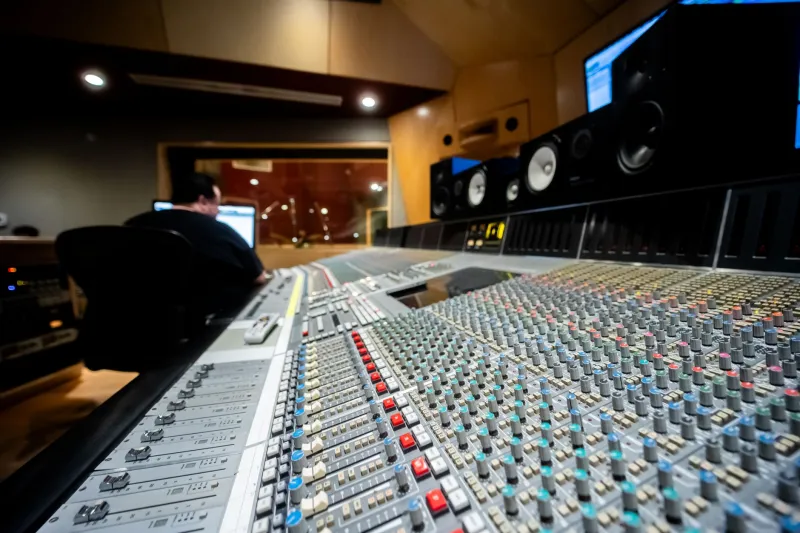
We talk endlessly about cinematography, about performances, about writing. But the most underrated manipulation happening inside your screen right now is acoustic. Audio engineers — the people nobody thanks at the Oscars — are running a quiet operation on your central nervous system every time you hit play.
The Quiet That Isn't Quiet
Here's the first thing to understand: silence in professionally mixed media doesn't actually exist. What sounds like silence to your ears is a precisely engineered audio bed — sometimes called room tone — that fills the space between sounds with just enough ambient texture to keep your brain from resetting.
When that room tone drops, even fractionally, your brain reads it as a threat signal. It's an evolutionary leftover. In the wild, sudden quiet meant a predator had just silenced the birds. Your amygdala doesn't know you're on a couch in Ohio. It just knows something stopped.
Sound designers exploit this constantly. A scene can be cut with perfectly ordinary visuals, but if the audio engineer slowly strips away the background hum — traffic noise, HVAC, birdsong — your body starts preparing for impact before anything on screen has changed. By the time the emotional beat arrives, you're already primed. The director gets the credit. The sound mixer got there first.
Frequency Is the Real Script
Dialogue operates in a specific frequency range — roughly 300Hz to 3,000Hz. Human ears evolved to prioritize that band. It's where we hear each other, process language, and decode emotional tone. But the frequencies below that range? Those don't get processed cognitively. They get processed physically.
Low-frequency audio — anything under 80Hz — doesn't really register as sound so much as sensation. It's why the bass in a movie theater feels like it's inside your ribcage. Sound designers working on prestige streaming content have increasingly started deploying sub-bass tones underneath emotionally loaded scenes. You don't hear a 40Hz drone. You feel a vague, sourceless unease. Your body interprets it as dread before your brain has a chance to form a thought about it.
This technique got mainstream attention when Christopher Nolan's team used it in Dunkirk, threading a literal ticking sound into the score's fabric so it registered as anxiety rather than music. But that's just the version you read about in a press release. Subtler versions of the same trick are in virtually every major streaming production you've watched this year.
The Algorithm Has an EQ Setting
Here's where it gets specifically 2024. Streaming platforms don't just distribute content — they're increasingly involved in how it sounds on your specific device. Netflix, for example, has invested heavily in what they internally call loudness normalization, a system that standardizes audio levels across their catalog so nothing sounds too jarring when you're autoplay-binging at midnight.
But normalization isn't neutral. When you compress audio to a standard loudness target, you make choices about what gets preserved and what gets flattened. Quiet, delicate sound design — the stuff that rewards a good pair of headphones — survives. Aggressive, percussive sound design gets tamed. The result is a catalog that subtly favors a certain emotional register: intimate, atmospheric, unnerving in a low-key way. That's not a coincidence. It's an editorial position expressed in decibels.
What you're watching is being emotionally color-graded in audio before it reaches your ears.
The Cut Isn't Visual — It's Sonic
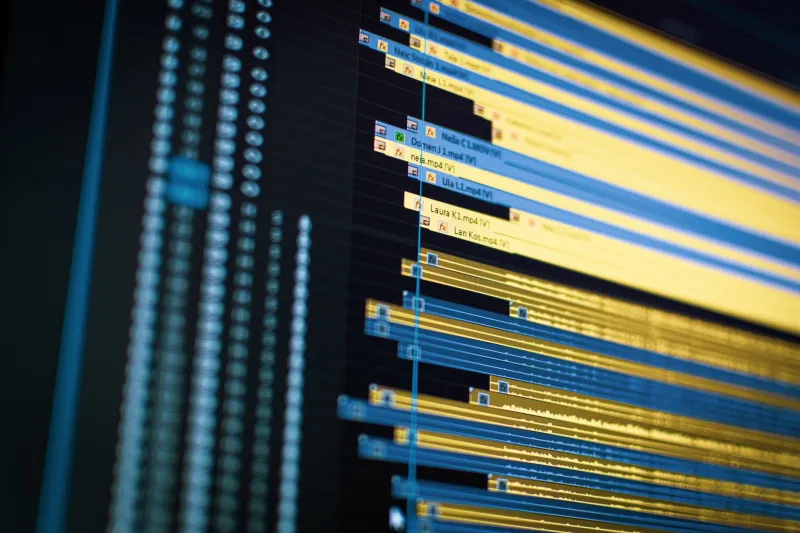
Film editing is taught as a visual discipline. Cut on action. Match the eyeline. Maintain spatial continuity. But working sound editors will tell you that the audio cut is the one that actually controls the emotional tempo of a scene.
When the sound of a scene ends before the picture cuts, your brain starts to detach. When the sound of the next scene begins while you're still looking at the current one, your brain bridges them emotionally — it reads the incoming audio as context for what you're still watching. This is called an L-cut or J-cut, and it's one of the most powerful tools in post-production.
A skilled editor can make you feel like two completely unrelated scenes are emotionally connected just by letting audio from one bleed into the other. You don't notice it. You just feel a vague, meaningful link between moments that, on paper, have nothing to do with each other. That's not storytelling. That's audio engineering masquerading as narrative.
Why You Cry at the Wrong Moment
You've probably had the experience of tearing up at a scene that, when you describe it to someone else, sounds completely ordinary. A character packing a bag. Someone sitting in a car. A door closing. These aren't objectively sad images. But paired with the right audio — a specific reverb tail, a particular frequency of ambient noise, a score element that mimics the rhythm of controlled breathing — they become devastating.
The reason is that emotional memory is stored partly as sound. Psychoacoustic research consistently shows that audio cues activate emotional recall faster and more reliably than visual ones. Sound designers know this. They're essentially picking locks on your personal emotional archive with frequencies you didn't know you'd saved.
When a scene hits different for you specifically — when your reaction is more intense than everyone else in the room — it's often because that audio signature accidentally matched something in your own memory bank. The sound designer didn't know about your personal history. They just knew the combination was likely to work on someone.
The Takeaway You Can't Unhear
None of this makes the experience less real. Feeling something — even if it was engineered — is still feeling something. But there's something worth sitting with in the knowledge that your emotional response to media is being shaped at a level below conscious perception, by people whose names scroll by in a font too small to read.
Next time a scene lands harder than you expected, pause for a second. Not to analyze it to death. Just to notice what's actually happening in the audio. Is the room tone dropping? Is there a low hum underneath the music? Did the sound from the next scene start before the cut?
You'll start hearing the architecture. And once you do, you can't fully un-hear it.
That's probably what the sound designers were counting on.